Pertussis vaccine failure and danger to immunocompromised
The Classic Baboon Study of Acellular Pertussis Vaccine Ineffectiveness
April 9, 2019
|
The baboon immune system is closely related to the human immune system. In this 2014 experiment, one group of baboons was vaccinated with the acellular pertussis vaccine, another received no vaccine, and a third the whole-cell vaccine. (Since the whole-cell vaccine was abandoned years ago as too dangerous, it is skipped here). Both the acellular and unvaccinated groups were exposed to pertussis virus.
In both groups, the noses and throats of the baboons were "colonized" by the bacteria, and thus could be shed, infecting others. As might be expected, the unvaccinated group "got sick" (showed symptoms), while the vaccinated group did not. But surprisingly, the unvaccinated group cleared the bacteria faster than the vaccinated group. 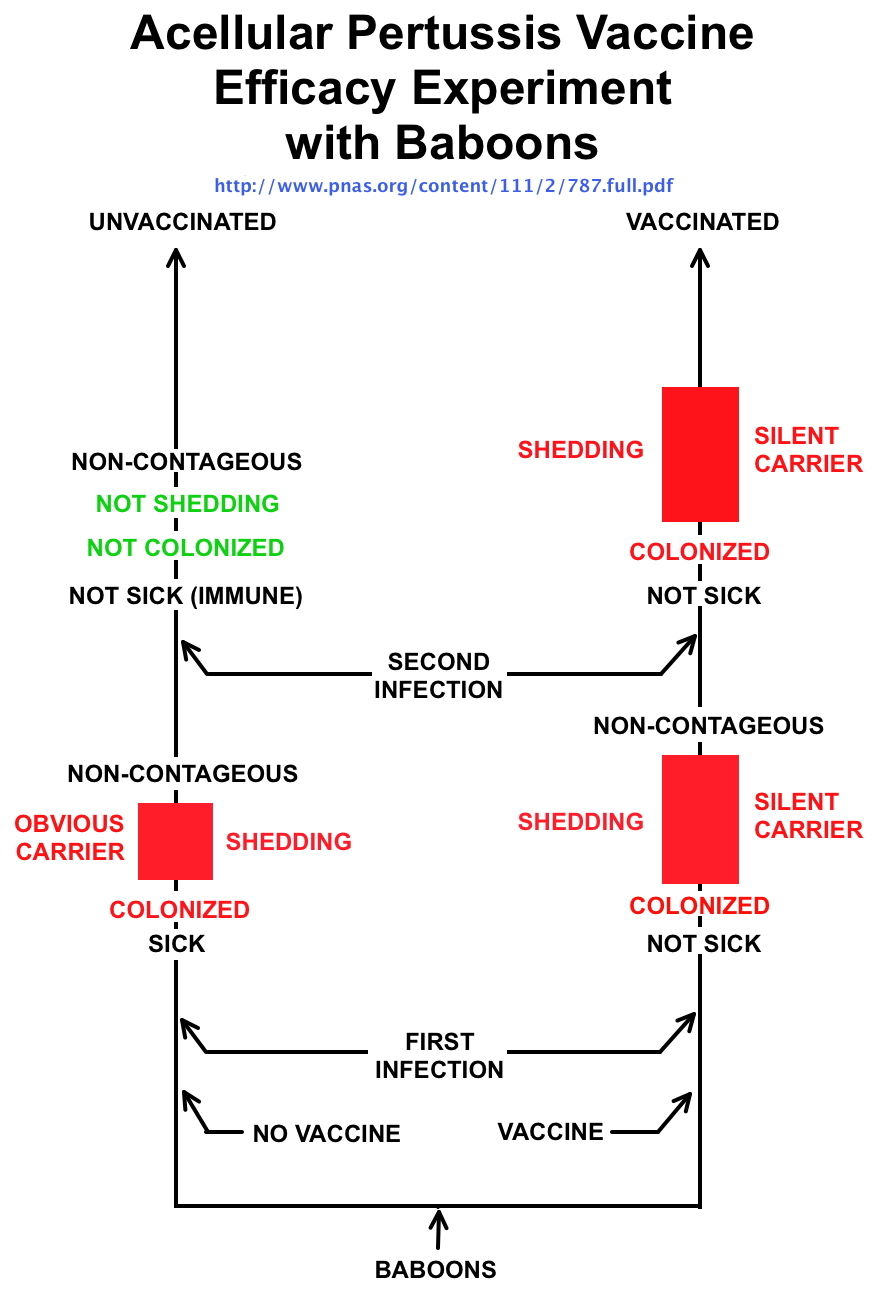
This result showed that vaccinated people are more capable of infecting others -- both in the aftermath of vaccination and during any subsequent (silent) infection -- than unvaccinated people, who can do so only during the first -- and only -- (visible) infection. This has direct relevance to the risk of infection of immunocomprised children in the classroom by unvaccinated vs. vaccinated children. |